
<?xml version="1.0" encoding="UTF-8"?>
<rss version="2.0"
	xmlns:content="http://purl.org/rss/1.0/modules/content/"
	xmlns:wfw="http://wellformedweb.org/CommentAPI/"
	xmlns:dc="http://purl.org/dc/elements/1.1/"
	xmlns:atom="http://www.w3.org/2005/Atom"
	xmlns:sy="http://purl.org/rss/1.0/modules/syndication/"
	xmlns:slash="http://purl.org/rss/1.0/modules/slash/"
	>

<channel>
	<title></title>
	<atom:link href="http://www.gearrunningstore.com/?feed=rss2" rel="self" type="application/rss+xml" />
	<link>http://www.gearrunningstore.com</link>
	<description></description>
	<lastBuildDate>Mon, 04 Feb 2013 03:14:48 +0000</lastBuildDate>
	<language>en</language>
	<sy:updatePeriod>hourly</sy:updatePeriod>
	<sy:updateFrequency>1</sy:updateFrequency>
	<generator>http://wordpress.org/?v=3.2.1</generator>
		<item>
		<title>Are You Ready For Natural Running Shoes?</title>
		<link>http://www.gearrunningstore.com/?p=351</link>
		<comments>http://www.gearrunningstore.com/?p=351#comments</comments>
		<pubDate>Mon, 30 Apr 2012 03:47:57 +0000</pubDate>
		<dc:creator>Paul</dc:creator>
				<category><![CDATA[Recent Posts]]></category>

		<guid isPermaLink="false">http://www.gearrunningstore.com/?p=351</guid>
		<description><![CDATA[With all the hype surrounding the natural running movement, perhaps the most important question to consider is, &#8220;Am I ready to make the transition?&#8221; Running in natural running footwear requires stronger, and more elastic muscles, tendons, and ligaments. Here is &#8230; <a href="http://www.gearrunningstore.com/?p=351">Continue reading <span class="meta-nav">&#8594;</span></a>]]></description>
			<content:encoded><![CDATA[<p>With all the hype surrounding the natural running movement, perhaps the most important question to consider is, &#8220;Am I ready to make the transition?&#8221; Running in natural running footwear requires stronger, and more elastic muscles, tendons, and ligaments. Here is an excellent self-assessment guide from physical therapist and gait expert, Jay Dicharry.</p>
<p><iframe width="640" height="360" src="http://www.youtube.com/embed/YtICeFOKjIs?fs=1&#038;feature=oembed" frameborder="0" allowfullscreen></iframe></p>
<p>Regardless of how you fared on the above assessment, one of the finest drills for building the necessary muscle memory while transitioning to natural running footwear is the century-old 100 up drill. This is best done barefoot, while concentrating on consistent, concise, and fluid movements. Christopher McDougall, author of the bestseller &#8220;Born To Run&#8221; demonstrates this invaluable drill.</p>
<p><iframe id="nyt_video_player" title="New York Times Video - Embed Player" src="http://graphics8.nytimes.com/bcvideo/1.0/iframe/embed.html?videoId=100000001149415&amp;playerType=embed" frameborder="0" marginwidth="0" marginheight="0" scrolling="no" width="480" height="373"></iframe></p>
<p>We also recommend doing many of your daily activities barefoot, or in light weight shoes. Davinci called the human foot a masterpiece of engineering and a work of art. Consisting of 26 bones, 33 joints, and over 100 muscles, tendons, and ligaments, the foot is incredibly complex, and sadly, often neglected in traditional footwear. The more we engage the feet by wearing &#8220;less shoe&#8221;, the stronger and more flexible they become. This last video, featuring our friend Dr. Mark Cucuzzella, highlights the beauty of natural running form, and is perhaps the finest tutorial we&#8217;ve seen.</p>
<p><iframe width="640" height="360" src="http://www.youtube.com/embed/zSIDRHUWlVo?fs=1&#038;feature=oembed" frameborder="0" allowfullscreen></iframe></p>
<p>Finally, here are three important considerations when making the transition to natural running shoes.</p>
<p><strong>1. Start slowly. </strong>Just as &#8220;Rome wasn&#8217;t built in a day&#8221;, natural running takes time and patience, particularly if you&#8217;re coming from a heel striking background. We suggest starting with one or two miles on your first day, and increasing your mileage in small increments on subsequent days. If you need to maintain higher mileage weeks, run the bulk of your miles in your &#8220;familiar&#8221; shoes, and change into your new shoes for the last couple of miles.</p>
<p><strong>2. Listen to your body. </strong>Your body will tell you when you&#8217;ve done too much. Many people experience tenderness in their quads, calves, achilles, and feet when transitioning. While some soreness is natural, persistent pain is not, and should be addressed by easing your mileage. Your body is a remarkable machine, and adjusts to these new stresses by becoming stronger and more efficient when you approach things gradually.</p>
<p><strong>3.</strong> <strong>Keep it simple.</strong> Try not to over think it. Natural running is graceful, requiring quick, light steps, under your center of gravity, an upright posture with a slight forward lean at the ankles, and a compact arm swing. We often tell our customers to pretend they are sneaking up on someone while running, by keeping their footfalls as quiet as possible. The less you hear the better.</p>
<p>Please feel free to contact us if you have any questions. We have four running coaches on our staff eager to help. Also, check out our <a href="http://www.facebook.com/gearrunning" target="_blank">Facebook page</a>, where the dialogue quite often revolves around natural running. Have fun, and we&#8217;ll look forward to seeing you in the store!</p>
]]></content:encoded>
			<wfw:commentRss>http://www.gearrunningstore.com/?feed=rss2&#038;p=351</wfw:commentRss>
		<slash:comments>0</slash:comments>
		</item>
		<item>
		<title>Natural Running Form</title>
		<link>http://www.gearrunningstore.com/?p=309</link>
		<comments>http://www.gearrunningstore.com/?p=309#comments</comments>
		<pubDate>Thu, 08 Sep 2011 19:08:52 +0000</pubDate>
		<dc:creator>Paul</dc:creator>
				<category><![CDATA[Recent Posts]]></category>

		<guid isPermaLink="false">http://www.gearrunningstore.com/?p=309</guid>
		<description><![CDATA[&#160; &#160; &#160; &#160; &#160; &#160; &#160; &#160; Form Matters The above photo, showing Craig Alexander passing Terenzo Bozzone, is a great example of how running form impacts one&#8217;s performance. We can all benefit from tweaking our form, and implementing &#8230; <a href="http://www.gearrunningstore.com/?p=309">Continue reading <span class="meta-nav">&#8594;</span></a>]]></description>
			<content:encoded><![CDATA[<p><a href="http://www.gearrunningstore.com/wp-content/uploads/2011/09/Crowie-and-Bozzone4.jpg"><img class="alignleft size-full wp-image-332" title="Crowie and Bozzone" src="http://www.gearrunningstore.com/wp-content/uploads/2011/09/Crowie-and-Bozzone4.jpg" alt="" width="495" height="324" /></a></p>
<p>&nbsp;</p>
<p>&nbsp;</p>
<p>&nbsp;</p>
<p>&nbsp;</p>
<p>&nbsp;</p>
<p>&nbsp;</p>
<p>&nbsp;</p>
<p>&nbsp;</p>
<p><strong>Form Matters</strong></p>
<p>The above photo, showing Craig Alexander passing Terenzo Bozzone, is a great example of how running form impacts one&#8217;s performance. We can all benefit from tweaking our form, and implementing some of the techniques Mr. Alexander demonstrates with such ease. At GEAR, we consider the following to be imperative for improving one&#8217;s form:</p>
<p>1. <strong>Foot Strike</strong>. The basic foot strike is similar to marching in place, with the forefoot landing first, followed by the heel gently settling. Gradually increase your cadence while maintaining the same foot placement until running in place. Now, lean forward at the ankles and let gravity take you forward (think &#8220;fall into the run&#8221;).</p>
<p>2. <strong>Body Position</strong>. Imagine having a string attached to the crown of your head pulling you upward, and one attached to your forehead pulling you forward. The ideal position is somewhat erect with a slight forward lean at the ankles.</p>
<p>3. <strong>Arm motion</strong>. With your arms at your side, raise your hands to a 90º (or less) angle while keeping your elbows at your side. As you begin running, concentrate on the backward swing of the arm motion. Reaching too far forward is wasted energy, especially when coupled with a side-to-side arm swing. Ideally, your arms should swing back until your hands are even with your side, and forward to the starting position.</p>
<p>4. <strong>Cadence</strong>. Maintaining a cadence of roughly 180 strides per minute helps prevent over-striding, vertical oscillation, heel striking, and &#8220;toeing off&#8221;.</p>
<p>Below is an excellent video of our friend Dr. Mark Cuccuzella running with impeccable form, sans shoes, though he typically runs in Newton&#8217;s. Notice how he lands under his center of gravity, has a slight forward lean at the ankles, touches the ground with his forefoot first, and lifts off after the heel gently settles. This running style produces twelve times less impact than a heel striking gait, and dramatically lessens one&#8217;s risk of injury.</p>
<p><iframe width="640" height="360" src="http://www.youtube.com/embed/kpnhKcvbsMM?fs=1&#038;feature=oembed" frameborder="0" allowfullscreen></iframe></p>
<p><strong>Four Helpful Mantras </strong></p>
<p>1. <strong>&#8220;Tap tap, not thud thud.&#8221;</strong> Listen to your footfall. The less you hear, the better.</p>
<p>2. <strong>&#8220;Ooh, Ooh, Ooh, Ooh!&#8221; </strong>Think of running on hot sand or coals, and quicken your step. Your feet should touch the ground lightly, then lift quickly.<br />
(Frank Shorter shared this mantra with us in Boulder last week.)</p>
<p>3. <strong>&#8220;Fall into the run.&#8221;</strong> Lean forward at the ankles and let your body propel itself forward.</p>
<p>4. <strong>&#8220;Smile through the miles.&#8221; </strong>Even if you have to force it during the later stages of a race, smiling has great psychological advantages, and uses less energy.</p>
<p><strong>GEAR as a Resource</strong></p>
<p>We love helping our customers become healthier, more efficient runners. Feel free to call us, or stop in with any questions. We also host running clinics, led by one (or several) of our five certified coaches. These are typically announced on Facebook (<a href="http://www.facebook.com/gearrunning">http://www.facebook.com/gearrunning</a>), and are highly beneficial for runners of all ability levels. We wish you all the best in your training, and look forward to hearing from, and seeing you soon!</p>
<p>&nbsp;</p>
<div class="fb-like" data-href="http://www.facebook.com/gearrunning" data-send="true" data-width="450" data-show-faces="true"></div>
]]></content:encoded>
			<wfw:commentRss>http://www.gearrunningstore.com/?feed=rss2&#038;p=309</wfw:commentRss>
		<slash:comments>0</slash:comments>
		</item>
		<item>
		<title>Natural Running Shoes</title>
		<link>http://www.gearrunningstore.com/?p=133</link>
		<comments>http://www.gearrunningstore.com/?p=133#comments</comments>
		<pubDate>Sat, 16 Apr 2011 01:47:51 +0000</pubDate>
		<dc:creator>Paul</dc:creator>
				<category><![CDATA[Recent Posts]]></category>

		<guid isPermaLink="false">http://www.gearrunningstore.com/?p=133</guid>
		<description><![CDATA[Less Is The New More? Nike Frees and Vibram FiveFingers Newton Distancias Natural running, also know as Chi, Pose, Evolution, and barefoot style running, has reached a &#8220;fever pitch&#8221; in our industry, of late. Concurrent studies being conducted at U.V.A. &#8230; <a href="http://www.gearrunningstore.com/?p=133">Continue reading <span class="meta-nav">&#8594;</span></a>]]></description>
			<content:encoded><![CDATA[<h2>Less Is The New More?</h2>
<p><a href="http://www.gearrunningstore.com/wp-content/uploads/2011/04/natural1.jpg"><img class="alignnone size-medium wp-image-153" title="natural" src="http://www.gearrunningstore.com/wp-content/uploads/2011/04/natural1.jpg?w=300" alt="" width="300" height="225" /></a></p>
<p><em>Nike Frees and Vibram FiveFingers</em></p>
<p><a href="http://www.gearrunningstore.com/wp-content/uploads/2011/04/Newton-Distancia.jpg"><img class="alignnone size-medium wp-image-290" title="Newton Distancia" src="http://www.gearrunningstore.com/wp-content/uploads/2011/04/Newton-Distancia-300x225.jpg" alt="" width="300" height="225" /></a></p>
<p><em>Newton Distancias</em></p>
<p>Natural running, also know as Chi, Pose, Evolution, and barefoot style running, has reached a &#8220;fever pitch&#8221; in our industry, of late. Concurrent studies being conducted at U.V.A. and Harvard on biomechanics, efficiency, and economy are supporting the premise that running with a simpler gait (landing on the midfoot, under one&#8217;s center of gravity, with a compact arm swing), lessens the risk of injury, and promotes a stronger, more efficient running style. Of course, no two runners are alike, and those wishing to dramatically change their running form (heavy heel strikers) should proceed with caution. At GEAR, we believe everyone can benefit from &#8220;tweaking&#8221; their form, and are happy to help you become better runners. We have three certified natural running coaches on our staff, weekly running clubs, informative books, and the Twin Cities largest selection of natural running footwear, to help in your transition.</p>
<p><a href="http://www.gearrunningstore.com/wp-content/uploads/2011/04/Natural-Running.jpg"><img class="alignnone size-full wp-image-282" title="Natural Running" src="http://www.gearrunningstore.com/wp-content/uploads/2011/04/Natural-Running.jpg" alt="" width="266" height="400" /></a></p>
<p><em>Danny Abshire&#8217;s Superb New Tome</em></p>
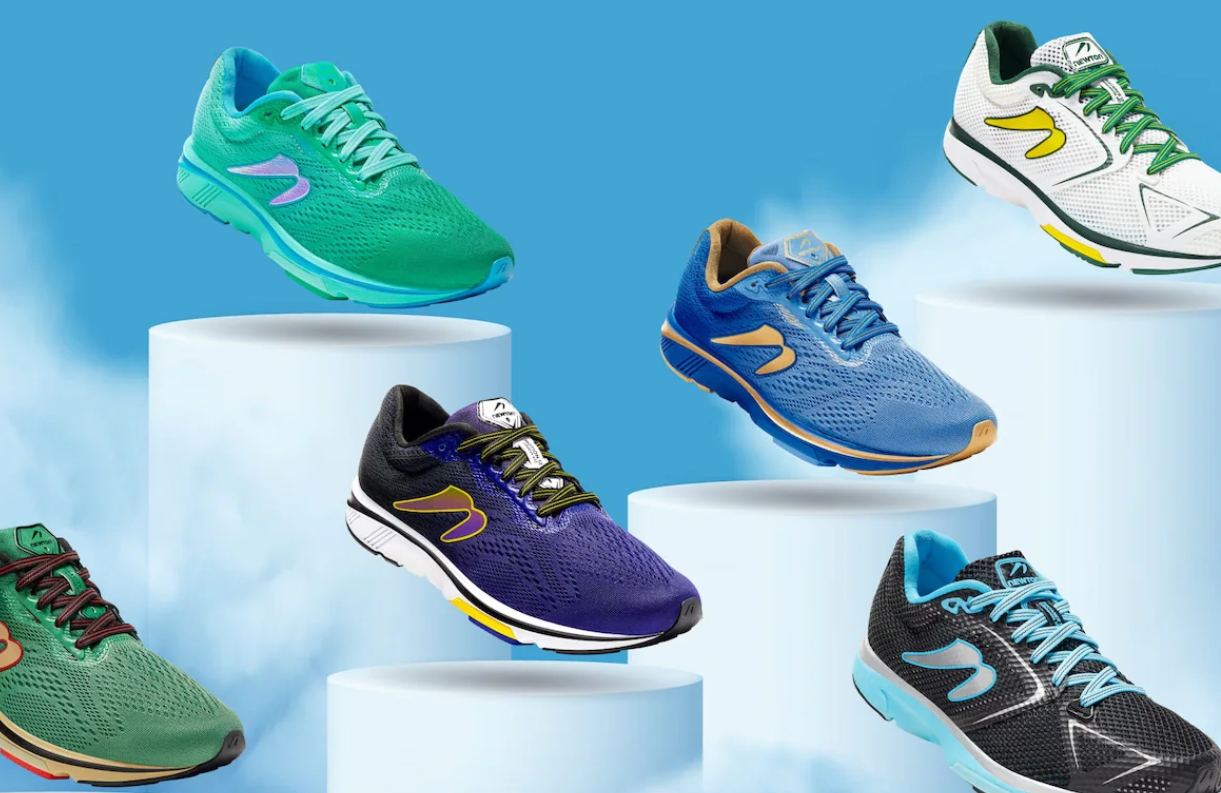
<p><span style="color: #000000;">Footwear plays a major role in fostering proper running mechanics. Generally, flatter shoes are preferable. Traditional running shoes have ramps (the differential from heel to forefoot) of 12-16mm, and tend to encourage a braking motion, or heel strike. The ramps on natural running shoes range from 0-7mm, making the heel less likely to engage with the ground, thus allowing one to work with gravity and move forward with less resistance. Boulder Colorado based, Newton Running, specifically designs their shoes to mimic the advantages of a barefoot running style, and have a patented forefoot (action/reaction technology) cushioning system that significantly lessens the risk of injury. Below is an excellent video discussing the merits of natural running form, and the unique appeal of Newtons.</span></p>
<p><iframe src="http://www.youtube.com/embed/1fBh2qH4QbM" frameborder="0" width="560" height="349"></iframe><br />
Our facebook page (<a href="http://www.facebook.com/gearrunning">http://www.facebook.com/gearrunning</a>) has generated much dialogue on this topic, and we&#8217;d love to hear from you. Ultimately, anything that keeps you running with a smile, is our goal. Happy running, and stay in touch!</p>
<div class="fb-like" data-href="http://www.facebook.com/gearrunning" data-send="true" data-width="450" data-show-faces="true"></div>
<p>&nbsp;</p>
]]></content:encoded>
			<wfw:commentRss>http://www.gearrunningstore.com/?feed=rss2&#038;p=133</wfw:commentRss>
		<slash:comments>0</slash:comments>
		</item>
	</channel>
</rss>